I Put My Own Company Through the Sam Altman Test
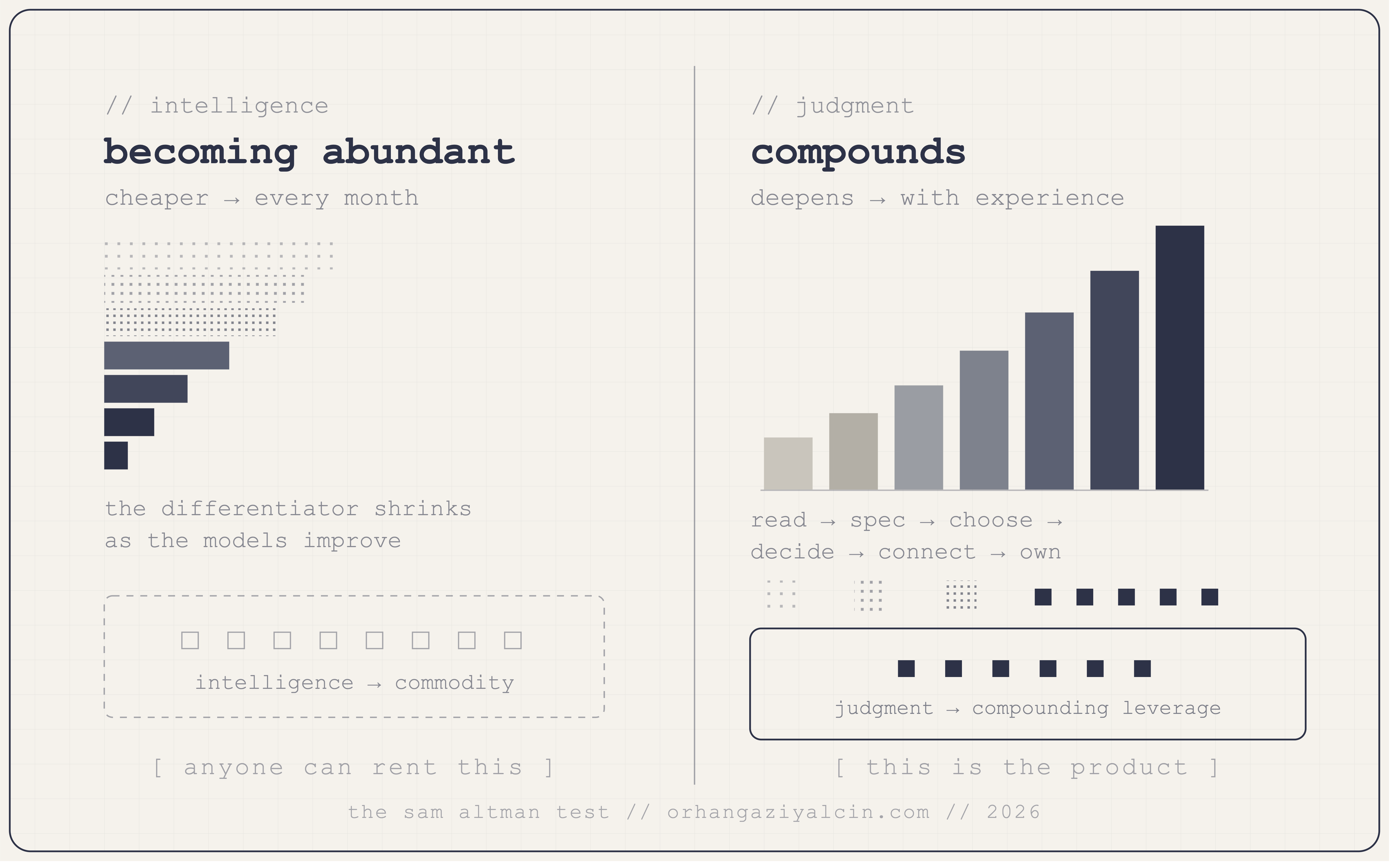
Intelligence is becoming the cheapest part of what we do. Judgment is becoming the whole business. The companies that understand the difference will spend the next few years getting stronger every time the models do.
The best question to ask about any business right now is not what it can build today. It is whether it gets stronger every time the models get smarter. A few weeks ago I finally held my own company up to that question, and the answer was not the one I expected.
I have been building Vizio AI for five years. We were optimizing our services long before "AI native" was a phrase anyone printed on a homepage. So when the market started talking about AI-native companies as if they had arrived overnight, it landed differently for me. We were already on the road. The real question was never whether to start walking it. It was whether the thing we built could actually scale into the AI-native service it always meant to be.
That question needs a test, not a slogan.
A Test, Not a Slogan
The cleanest one I have found comes from Sam Altman: build businesses that get stronger as the models get more intelligent. I treat it like litmus paper. You hold your business up to it and watch which way it turns.
The test is unforgiving precisely because it is simple. If a smarter model makes your product redundant, you were never building a business. You were renting a gap in the technology, and the rent was always going to come due.
If a smarter model makes you better, you built something with leverage. The model becomes a multiplier on what you already do well, instead of a replacement for it.
Most companies do not know which side of that line they are on. So I made myself answer for mine.
The Uncomfortable Version of the Question
Here is the version that actually stings. A large part of what we do is intelligence work: reading, analyzing, designing, building, deciding. If the models keep getting smarter, and they will, what is left that is genuinely ours?
If the honest answer is "nothing, the model will eventually do all of it," then Vizio AI fails the test, and I would rather know that now than later.
I sat with it for a while. The answer, once it surfaced, was almost embarrassingly simple.
What Makes a Service Unique Was Never the Intelligence
It is the judgment.
Intelligence is becoming abundant. It is getting cheaper and more available every month, and that trend is not slowing down. Judgment is not following the same curve. Judgment is what decides where to point the intelligence, what to ignore, what a client actually meant, and what "good" looks like when nobody has written it down.
A service is not valuable because it is smart. It is valuable because it knows what to do with smart.
Once I framed it that way, the question stopped being "will the model replace us" and became something sharper: where does our judgment actually live, and is the model a threat to it or a multiplier on it?
So I Went Looking for Where the Judgment Actually Lives
It turns out there is more of it than I realized, and most of it sits in places a model cannot reach on its own.
It starts before any work begins. A client gives you limited information, and the most important part is usually the part they did not write down. The tone, the emphasis, the hesitation, the thing they keep circling back to, the goal sitting underneath the request. Written text strips most of that out. Reading the real objective from incomplete and lossy signals is judgment, and it is the first thing everything else depends on.
Then that reading has to become a specification: what to build, why it matters to the business, and how it holds together technically. Translating a half-spoken ambition into a product spec that is both commercially right and technically sound is judgment.
Then comes the venture cycle itself: ideation, validation, building the MVP, launching, scaling, optimizing, and eventually exiting. There are a million ways each stage can go. Knowing which way to take, when to push and when to cut, is not something you retrieve from a model. It comes from having been through the cycle enough times to feel where it bends.
There is also the data problem. A lot of what matters is not sitting behind an API. Some of it is never transmitted at all, because the client does not know it is signal. Capturing that, and making sense of it through years of pattern recognition in the field, is judgment that no amount of model capability hands you for free.
And then we do the actual work with AI: design, programming, testing. This is the part everyone points to when they say AI will replace services. But it is one node in the chain. It is not the chain.
Finally, the output usually has to connect to something that cannot be automated, either because automation is not feasible yet or because it is genuinely impossible. A human approval, a regulated step, a physical process, a decision someone has to own. We treat that non-automated step as an input to design around, not a failure to apologize for.
The Pattern Underneath All of It
Every one of those is a judgment node. The model is a tool inside each node. It is not the node.
| Intelligence (becoming abundant) | Judgment (compounds with experience) |
|---|---|
| Generating designs, code, and tests | Knowing what to build and why it matters to the business |
| Summarizing what a client wrote | Reading what a client meant but did not write |
| Processing data exposed by an API | Capturing signal that no API exposes and the client never sends |
| Producing an output | Deciding what "good" looks like when nobody defined it |
| Running a step | Designing around the steps that cannot be automated at all |
Read the two columns honestly. The left side gets cheaper and better every month, and that is good for us, because it is most of the manual cost. The right side does not commoditize. It deepens.
Why This Passes the Test
Here is the part that actually answered my question.
A smarter model does not erode the judgment-heavy work. It amplifies it. When the model gets better at design, programming, and testing, our people spend less time producing and more time deciding. The expensive, slow, mechanical middle shrinks. The judgment at the front and the back of the work, the part clients actually pay for, gets more room and more leverage.
A smarter model is a multiplier on judgment, not a substitute for it. The more judgment-dense your work is, the more you gain every time the models improve.
That is what it means to pass the test. Not to be untouched by AI. To be built so that every advance in AI makes the business stronger rather than thinner.
The services that fail the test are the ones where the work is mostly the mechanical middle, with no judgment at either end. Those get compressed to nothing, and quickly. The services that pass are the ones where intelligence was always the input and judgment was always the product.
We spent five years, mostly without naming it, building toward the second kind.
Three Questions to Run Your Own Business Through
1. If the model got twice as smart tomorrow, would you be more valuable or less? If the honest answer is "less," your value was the gap, not the work. The gap is closing.
2. Where does your judgment actually live? Name the specific moments. Reading the real goal. Choosing the path. Knowing what good looks like. If you cannot name them, you may be selling the mechanical middle without realizing it.
3. Is the model a threat to that judgment or a multiplier on it? This is the whole test in one line. Build so the answer is "multiplier," and every model release starts working for you instead of against you.
Intelligence is becoming the cheapest part of what we do. Judgment is becoming the whole business. The companies that understand the difference will spend the next few years getting stronger every time the models do.